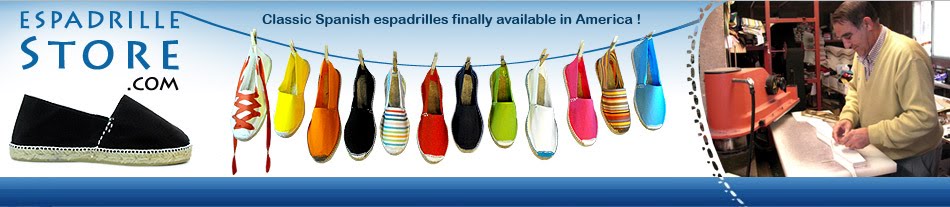
Welcome to THE ESPADRILLES, the first website entirely dedicated to the famous Spanish espadrilles!

The espadrille (alpargatas) is a shoe from the Basque country (Spain), made of cotton or linen fabric with a flexible jute rope sole. This authentic Spanish product has been handcrafted for many generations in several small villages and has, therefore, a very long history associated with it. Entirely handmade, the espadrille symbolizes an ecological, easy going and dynamic lifestyle.

Our Spanish espadrilles are designed for HER as well as for HIM. They are made for people who like practical and comfortable shoes, and who care for the environment. Fabrics are natural, soft and top quality and are available in a great choice of colors.

Jute, a 100% natural fiber, is used in the making of modern espadrille soles. Woven jute is very popular because of its eco-friendliness compared to synthetic substances.

If you are looking to purchase a pair of espadrilles for yourself, have a look at the 'choose your espadrilles' section of our website, it will link you to our espadrilles store website. If you have a shop and would like to carry this unique brand of shoes, contact us in order to activate your wholesale account.

The espadrilles team is entirely at your disposal for any questions you might have.

Welcome aboard!
Diego Arnedo
Espadrilles - Spain at your feet -

CHOOSE YOUR ESPADRILLES:

The history of the espadrilles

The history of the espadrille

The espadrille has been around for centuries maybe even thousands of years. The Archaeological museum of Granada owns a pair of espadrilles that were found on human remains inside the “cueva de los murielagos” (the bat-cave). It is estimated that these shoes are around 4000 years old. Clearly, they are a very primitive version of today’s alpargatas.


This light sandal, made with jute rope or braided hemp and with linen fabric, comes from Spain, where, already, they were being worn around the XIII century by the King of Aragons’ infantry men. Its name is derived from “esparto” which is a kind of plant that was originally burned then braided to make the soles.


It was during the XIII century that the production of these shoes truly spread. Since it is a handcrafted shoe, making the treads employs many workers. The alpargatero’s (or espadrille maker) only job was to make the rope soles, while the seamstresses sewed the fabric and the band. At the beginning of the XIX century, Mauléon (a French city located in the Atlantic Pyrenees) began selling them in vast quantities. The first people to wear them were the catalano-aragonese military soldiers then subsequently by the priests. Around 1880, most espadrilles were sold to mine workers, but they were also exported to South America. It was the time of the “hirondelles”, which were young girls from the aragonese valleys who came to work in the espadrille factories between the fall and winter seasons.


Traditionally, the alpargata was either black or it was left in its natural coloured fabric (the lighter version was worn on Sundays and the darker version during the week), and each region makes the alpargata in its own unique way. The ones made in Emporda are white and decorated with five bands of colour over the top of the shoe. One of the most famous designs made of white single-coloured fabric is worn by the Sardanes Dancers (traditional catalan dance).


Around 1950, fashion evolved and this forced alpargata makers to reinvent the shoe with a more sophisticated design that was better suited to the times. This contributed, during the 1960s, to a special order of shoes for the Parisian festivities by the most celebrated designer of the time, Mr. Yves St-Laurent. He asked for an espadrille with a heel, which had never been done before. Suddenly, it was all the rage! Today, almost all the women who live in the southern regions have a pair of alpargatas with heels and ribbons that tie around the ankle.


Today, espadrilles are still extremely popular both in France and in Spain, especially in the summer. People seemed to like it because of the sole, which is 100% natural, molds itself to the shape of the foot, and allows the skin to breathe. The simplicity of this shoe makes very versatile and therefore easy to match with all sorts of different styles. If the espadrille has already been around for 4000 years then it’s not about to go out of fashion now!!

HAND SEWN ESPADRILLES

Allow me to introduce you to Rosa, one of the many “abuelas” (grandmothers) living in a small village (population 2000) in the north of Spain. In a hand full of Spanish villages, the centuries old tradition of villagers hand sowing the espadrille in the comfort of their own home still remains.

These adorable abuelas sew the espadrilles by hand with an ancestral technique, always using the same tools and making the exact same motions. The pictures below will help you appreciate in detail the full charm of the technique.

See for yourself how Rosa receives at home the different elements (sole, fabric and thread) and assembles them with amazing speed while gossiping with friends.


video


BRAIDING THE JUTE ROPE

These braiding machines dating from the 50's are still in use in the village. The jute thread spins and forms the rope used to make the soles of the espadrilles.


PREPARING THE JUTE SOLES


And here’s Ramon Junior! Now that the rope is ready, his work consists in rolling the jute in order to form the soles. To do so, he uses a turning table that has been used for generations by his family.


SEWING THE SOLES

Hand sewing the soles is the key to a solid espadrille; as you can see, Ramon sews on a special bench called "banco alpargatero", used in his family for many generations.


SOLES MADE OF NATURAL RUBBER

Paco the rubber man! In order to finish the sole, natural rubber will be vulcanized to the jute with the help of a heated mold (400º Celsius). This rubber sole will solidify the jute and provide a good grip to the sole.


THE DELICATE ART OF TAILORING

Here's Ramon again! He will not share the responsibility of his delicate tailoring job, cutting the fabric is the most difficult part of the "espadrille" operation!


espadrilles eco friendly

ECO friendly

Today, with the tremendous increase in consumption and pollution, there are growing concerns about the environment. It is therefore very important to offer to the public products using less and less polluting chemical substances. This is why we have chosen the espadrille, a shoe that meets all environmental criteria.

-it is completely biodegradable

-no chemical products are used in its manufacture

-it is made with natural fibres only (flax and jute)

-natural rather than artificial rubber is used to waterproof the sole


All the materials used in the manufacture of the espadrille are described below:


Jute

Jute is used to make the soles. The use of jute is beneficial for the environment since this natural and renewable fibre is also completely biodegradable and can be used as a fertilizer. This is one of the most environment friendly material as its cultivativation does not require pesticides and its transformation does not require environmentally harmful products unlike cotton, the conventional cultivation of which uses 24% of the pesticides sold in the world and represents only 2.4% of the agricultural area in use.

Few materials are as environmentally safe as jute.


Flax

Flax is the oldest textile material. It is also one of the few textile fibres producing plant gowing in Europe. The technical charateristics of flax fibres are rather exceptional. Flax can absorb a lot of water and its fibre is very strong and fine. Unlike its synthetic competitors, this fibre is not affected by UV radiation from the sun.

Flax cultivation and transformation are very safe for the environment. An environmental balance established over a period of a year and a half shows that flax wins one of the first places as far as compliance with environmental legislation is concerned. This is why it is so popular today.


Natural rubber

Rubber is an elastic waterproof material made with the latex produced by the rubber tree growing in southern regions. It is first dried and then purified by a boiling and cleaning process. Natural rubber has properties that cannot be matched by synthetic rubber made from oil. Its production is less energy-consuming and polluting than synthetic rubber.

espadrilles wholesale

ESPADRILLES WHOLESALE

The Advantages of purchasing directly from Espadrilles®
By purchasing directly from Espadrilles® you will receive special newsletters, up-to-date product information and outstanding customer service from our friendly sales team. We will also assign you a dedicated sales representative who will make purchasing from Espadrilles® an easy, enjoyable and profitable experience. New account "specials" are always available and low initial order minimums will help you get started selling the Spanish espadrilles today.


Let's get your account started
Wholesale pricing is available to those who have a business license and/or resale certificate, and meet the criteria of having a brick and mortar store, an online store or operate a print catalog business. Espadrilles® is no longer taking on Ebay only accounts. If you are interested in becoming a wholesale account customer, please contact us and we will be happy to assist you.

Espadrilles categories


Hall of fame

Espadrilles have been worn by many artists such as Pablo Picasso and Salvador Dali, their relaxed personal style that helped make the shoes very popular. Afterwards, it was because of celebrities like Grace Kelly, Jacqueline Kennedy, Catherine Deneuve, Caroline de Monaco, Jack Nicholson, Michael Douglas, Sophia Loren, Her Majesty Sophia, Queen of Spain and even Jean-Paul II that the espadrilles’ popularity continued to grow. Even Gaston Lagaffe (Euro-comic book hero) made it his trade-mark shoe.

Sophia Loren also glamourized the alpargata in the 1960s, parading the pages of glossy fashion mags in high-heeled espadrilles with boldly coloured ribbons criss-crossing her calves. You’ll still see them on the Paris runways (and on Paris Hilton) but in fact alpargatas are of humble origins, shoes of the paisanos, simple country folk who tilled the soil and lived off the land. The very espadrille ribbons that Sophia Loren strutted to stardom were born out of the most practical of necessities: to keep the alpargata snugly on as the farmer sloughed through the manure of his field at the crack of dawn. The official gala uniform of the Mosses d’Esquadra, Catalunya’s national police force, includes a sombrero de copa (top hat) to represent the rich, and espardenyas for the working class. In staying true to their roots, alpargatas are still remarkably cheap.


Salvador Dali


Young JFK


Grace Kelly


Grace Kelly with Cary Grant in Barcelona, 1952


Ernest Hemingway


Penelope Cruz


Doña Sofia, queen of Spain


Don Johnson, Miami vice


Gaston Lagaffe (famous European comic book character)


Etc...